
Insights
Decree 399/2026/ND-CP: Vietnam Regional Minimum Wage 2027 (PDF)
 LinkedIn ↗
By Nguyen Quoc Trung — Deputy General Director · Updated
Decree 399/2026/ND-CP sets the regional minimum wage from 1 January 2027 at VND 5,700,000/month in Region I, VND 5,080,000 in Region II, VND 4,450,000 in Region III and VND 4,040,000 in Region IV; the hourly rates are VND 27,400, 24,400, 21,400 and 19,400. The Government signed and issued it on 2 November 2026, replacing Decree 293/2025/ND-CP. This article summarises all 5 articles and the annex, compares rates with 2026, lists the areas moved to a higher region and provides the full PDF to download; content updated 3 November 2026.
Decree 399/2026/ND-CP — quick summary:
- Decree No. 399/2026/ND-CP, signed 2 November 2026; signed by Deputy Prime Minister Pham Thi Thanh Tra on behalf of the Prime Minister, on the proposal of the Minister of Home Affairs.
- Takes effect on 1 January 2027; Decree 293/2025/ND-CP ceases to apply on the same date (Article 5(1), Article 5(2)).
- Monthly minimum wage rises by VND 310,000–390,000, equivalent to 7.3–9.2% depending on the region (Article 3(1)).
- The new list of areas covers 34 provinces and cities, drawn up by commune, ward and special zone (Annex).
- 7 localities have areas moved to a higher region compared with 2026: Ho Chi Minh City, Hai Phong, Quang Ninh, Dong Nai, Da Nang, Gia Lai and Hung Yen.
- Businesses must review employment contracts, collective labour agreements and pay regulations before the January 2027 payroll (Article 5(3)).
What is Vietnam's regional minimum wage in 2027 under Decree 399/2026/ND-CP?
The 2027 regional minimum wage in Vietnam is VND 5,700,000/month (Region I), VND 5,080,000/month (Region II), VND 4,450,000/month (Region III) and VND 4,040,000/month (Region IV); the hourly rates are VND 27,400, 24,400, 21,400 and 19,400, under Article 3(1) of Decree 399/2026/ND-CP, effective from 1 January 2027.
| Region | Monthly rate 2027 (VND/month) | Hourly rate 2027 (VND/hour) | Monthly rate 2026 (VND/month) | Increase (VND/month) | Increase (%) |
|---|---|---|---|---|---|
| Region I | 5,700,000 | 27,400 | 5,310,000 | +390,000 | +7.3% |
| Region II | 5,080,000 | 24,400 | 4,730,000 | +350,000 | +7.4% |
| Region III | 4,450,000 | 21,400 | 4,140,000 | +310,000 | +7.5% |
| Region IV | 4,040,000 | 19,400 | 3,700,000 | +340,000 | +9.2% |
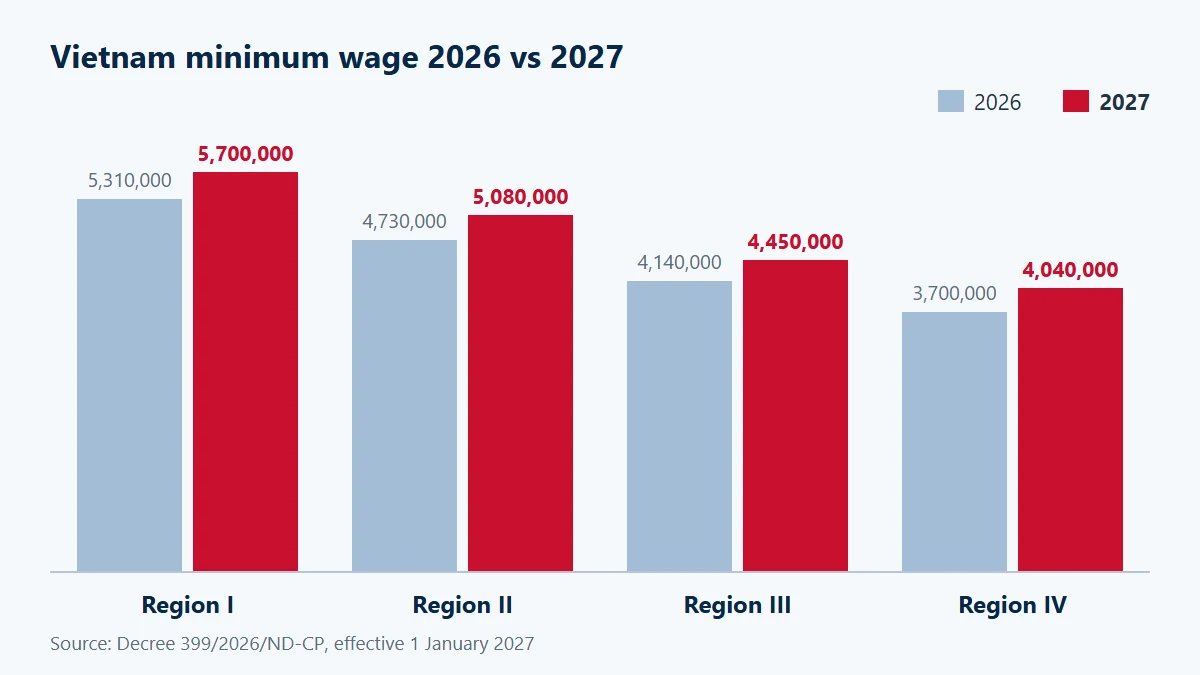
Region IV has the highest percentage increase (9.2%). The gap between Region I and Region IV rises slightly in absolute terms, from VND 1,610,000 to VND 1,660,000, but narrows as a percentage, from 43.5% to 41.1% of the Region IV rate. The hourly rate rises by VND 1,400–1,900, or 7.0–9.0%.
When does Decree 399/2026/ND-CP take effect and what does it replace?
Decree 399/2026/ND-CP takes effect on 1 January 2027 and replaces Decree 293/2025/ND-CP of 10 November 2025, which ceases to apply from that date (Article 5(1), Article 5(2)). The January 2027 payroll is the first payroll to which the new rates must be applied.
The Decree was issued under Law on Government Organisation No. 63/2025/QH15, Law on Local Government Organisation No. 72/2025/QH15 and the 2019 Labour Code No. 45/2019/QH14. The digitally signed document was timestamped 21:11 on 2 November 2026; the signatory was Deputy Prime Minister Pham Thi Thanh Tra, acting on behalf of the Government and signing in place of the Prime Minister.
Where can I download the full text of Decree 399/2026/ND-CP (PDF)?
You can download the full text of Decree 399/2026/ND-CP including the Annex listing areas from Decree 399/2026/ND-CP – 14-page PDF. The file is 14 pages, approximately 4.4 MB: 4 pages of decree text and 10 pages of annexes, assembled in page order from photographs of the signed and stamped Government copy.
Once the document is published in the Official Gazette and on the Government's e-portal, businesses should cross-check against the official published version before using it as a legal reference.
What articles does Decree 399/2026/ND-CP contain?
Decree 399/2026/ND-CP contains 5 articles and 1 annex. The content of each article is summarised in the table below.
| Article | Main content |
|---|---|
| Article 1. Scope | Sets the monthly and hourly minimum wage by region, applicable to employees working under an employment contract. |
| Article 2. Scope of application | Employees working under an employment contract; employers comprising enterprises, agencies, organisations, cooperatives, households and individuals that hire workers; relevant agencies, organisations and individuals. |
| Article 3. Minimum wage rates | Table of monthly and hourly rates for 4 regions (clause 1); list of areas in the Annex (clause 2); 5 principles for determining the region by place of operation (clause 3, points a–e). |
| Article 4. Applying the minimum wage | The monthly rate is the floor for employees paid by the month; the hourly rate is the floor for employees paid by the hour; conversion formulas for weekly, daily, output and lump-sum pay (clauses 1–3). |
| Article 5. Effect and responsibilities | In force 1 January 2027; Decree 293/2025/ND-CP ceases to apply; responsibility to review contracts, collective agreements, pay regulations and to maintain more favourable arrangements. |
| Annex | List of areas to which the minimum wage applies from 1 January 2027, covering 34 provinces and cities. |
How does Decree 399 differ from Decree 293/2025?
Decree 399 differs from Decree 293/2025 on three points: higher monthly and hourly minimum wages, a new effective date of 1 January 2027, and the reclassification of certain areas in 7 localities into a higher region. The rules for determining the region and the conversion formulas for weekly, daily, output and lump-sum wages are unchanged from 2026.
| Item | Decree 293/2025/ND-CP | Decree 399/2026/ND-CP |
|---|---|---|
| Effective date | 1 January 2026 | 1 January 2027 |
| Region I (VND/month) | 5,310,000 | 5,700,000 |
| Region II (VND/month) | 4,730,000 | 5,080,000 |
| Region III (VND/month) | 4,140,000 | 4,450,000 |
| Region IV (VND/month) | 3,700,000 | 4,040,000 |
| Hourly rates Regions I–IV (VND/hour) | 25,500 / 22,700 / 20,000 / 17,800 | 27,400 / 24,400 / 21,400 / 19,400 |
| Unemployment insurance cap Region I (20×) | 106,200,000 | 114,000,000 |
| List of areas | 34 provinces and cities | 34 provinces and cities; 7 localities with areas moved to a higher region |
Compared with the Ministry of Home Affairs draft released in July 2026, the wage rates are unchanged but the published decree moves more areas up: the entire remaining area of Ho Chi Minh City and Hai Phong moves to Region II, Quang Ninh no longer has any Region IV areas, and Quy Nhon and Pleiku move to Region II. Point c of Article 3(3) also adds special economic zones, free trade zones and high-tech agricultural zones to the group of zones that apply the highest rate.
Which areas are moved to a higher minimum-wage region from 1 January 2027?
From 1 January 2027, 71 named communes, wards and special zones move to a higher region, along with the entire remaining portion of Ho Chi Minh City, Hai Phong, Quang Ninh and Hung Yen; other provinces and cities retain the same regions as 2026. The table below compares the annex to Decree 399/2026/ND-CP with the annex to Decree 293/2025/ND-CP.
| Province / city | Area | 2026 | From 1 January 2027 |
|---|---|---|---|
| Ho Chi Minh City | Ba Ria, Long Huong, Tam Long wards; Kim Long, Chau Duc, Ngai Giao, Nghia Thanh, Long Hai, Long Dien, Binh Khanh, An Thoi Dong, Can Gio, Thanh An communes; Con Dao special zone | Region II | Region I |
| Ho Chi Minh City | All remaining communes, wards and special zones (such as Xuyen Moc, Ho Tram, Binh Chau, Dat Do, Phuoc Hai, Binh Gia) | Region III | Region II |
| Hai Phong | Thanh Ha, Ha Tay, Ha Bac, Ha Nam, Ha Dong, Ninh Giang, Vinh Lai, Khuc Thua Du, Tan An, Hong Chau, Thanh Mien, Bac Thanh Mien, Nam Thanh Mien, Hai Hung communes | Region II | Region I |
| Hai Phong | All remaining communes and wards (Bach Long Vi special zone remains Region II) | Region III | Region II |
| Quang Ninh | Mong Duong, Quang Hanh, Cam Pha, Cua Ong wards; Hai Hoa commune | Region II | Region I |
| Quang Ninh | Tien Yen, Dam Ha, Quang Ha, Duong Hoa, Quang Duc, Cai Chien communes; Van Don special zone | Region III | Region II |
| Quang Ninh | All communes, wards and special zones previously in Region IV (Dien Xa, Dong Ngu, Hai Lang, Quang Tan communes remain in Region III) | Region IV | Region III |
| Dong Nai | Binh Phuoc ward; Cam My, Dinh Quan, Tan Phu, Thuan Loi communes | Region II | Region I |
| Dong Nai | Phuoc Long ward; Tan Khai commune | Region III | Region II |
| Da Nang | Dien Ban, Dien Ban Dong, Dien Ban Bac, An Thang wards; Dien Ban Tay, Go Noi communes | Region III | Region II |
| Gia Lai | Quy Nhon, Quy Nhon Dong, Quy Nhon Tay, Quy Nhon Nam, Quy Nhon Bac, Pleiku wards | Region III | Region II |
| Gia Lai | Binh Dinh, An Nhon, An Nhon Dong, An Nhon Nam, An Nhon Bac, Bong Son, Hoai Nhon, Tam Quan, Hoai Nhon Dong, Hoai Nhon Tay, Hoai Nhon Nam, Hoai Nhon Bac wards | Region IV | Region III |
| Hung Yen | All communes and wards not listed in Region II and Region III in 2026 | Region IV | Region III |
For businesses with factories, warehouses or shops in these areas, the floor rises twice: once from the new rate and once from the region upgrade. For example, a position in Cam My commune (Dong Nai) was subject to the Region II rate of VND 4,730,000 in 2026; from 1 January 2027 it is subject to Region I at VND 5,700,000, an increase of VND 970,000/month (20.5%).
Which region covers Ho Chi Minh City, Hanoi, Binh Duong and Dong Nai in 2027?
In 2027, most of Ho Chi Minh City (including the former Binh Duong and Ba Ria – Vung Tau provinces) falls in Region I, with the remainder in Region II; Hanoi has 104 communes and wards in Region I, with the rest in Region II; Dong Nai has all four regions from Region I to Region IV. The table below counts the communes, wards and special zones listed by name in each region; specific names can be found in the full list at the end of this article.
| Province / city | Region I | Region II | Region III | Region IV |
|---|---|---|---|---|
| Ha Noi City | 104 communes/wards | Remaining | – | – |
| Ho Chi Minh City | 158 communes/wards | Remaining | – | – |
| Hai Phong City | 113 communes/wards | Remaining | – | – |
| Da Nang City | – | 30 communes/wards | 29 communes/wards | Remaining |
| Can Tho City | – | 19 communes/wards | 35 communes/wards | Remaining |
| Dong Nai City | 47 communes/wards | 20 communes/wards | 16 communes/wards | Remaining |
| Bac Ninh City | – | 53 communes/wards | 14 communes/wards | Remaining |
| Tay Ninh Province | 20 communes/wards | 29 communes/wards | 34 communes/wards | Remaining |
| Quang Ninh City | 36 communes/wards | 7 communes/wards | Remaining | – |
How is the minimum-wage region determined by the place of work?
The minimum-wage region is determined by where the employer operates: each unit or branch operating in an area applies the minimum wage for that area, not one rate based on the head office (Article 3(3)(a), Article 3(3)(b) of Decree 399/2026/ND-CP). Article 3(3) sets out 5 principles:
- Point a: an employer operating in an area applies the minimum wage set for that area.
- Point b: units and branches in areas with different rates each apply the rate for the area where they operate.
- Point c: a unit in an industrial park, export processing zone, high-tech zone, concentrated digital technology zone, special economic zone, free trade zone or high-tech agricultural zone that spans areas with different rates applies the highest rate among them.
- Point d: where an area is renamed or split, the rate of the area before renaming or splitting applies temporarily until the Government issues new rules.
- Point e: where a new area is formed from one or more areas with different rates, the highest rate among them applies temporarily until the Government issues new rules.
For seconded or outsourced workers doing their work at a client's factory, Nhan Kiet determines the region by where the worker actually works and keeps a lookup record for each site for inspection purposes.
How are weekly, daily, output and lump-sum wages converted to check against the minimum wage?
Weekly, daily, output or lump-sum wages must be converted to a monthly or hourly figure and must not fall below the regional monthly or hourly minimum wage; the normal working hours used for the conversion are chosen by the employer in accordance with labour law (Article 4(3) of Decree 399/2026/ND-CP). The specific formulas are in the table below.
| Pay form | Convert to monthly (point a) | Convert to hourly (point b) |
|---|---|---|
| Weekly | Weekly wage × 52 weeks ÷ 12 months | Weekly wage ÷ normal working hours per week |
| Daily | Daily wage × normal working days per month | Daily wage ÷ normal working hours per day |
| Output / lump-sum | Output/lump-sum pay earned in normal working hours of the month | Output/lump-sum pay ÷ hours worked in normal working hours |
For example, in Region I in 2027: a daily wage of VND 220,000, 26 working days a month, 8 hours a day. Monthly conversion: 220,000 × 26 = VND 5,720,000, above VND 5,700,000, so valid. Hourly conversion: 220,000 ÷ 8 = VND 27,500, above VND 27,400, so also valid. If the daily wage were only VND 215,000, the monthly conversion would be VND 5,590,000, below the Region I minimum.
Who does the monthly and hourly minimum wage apply to?
The monthly minimum wage is the floor for employees paid by the month who work full normal hours and meet output norms, while the hourly minimum wage is the floor for employees paid by the hour (Article 4(1), Article 4(2)). Both apply to all employees working under an employment contract under the Labour Code (Article 2(1)), including part-time, seasonal and probationary workers employed under an employment contract.
People working under a services contract, a civil lump-sum contract or another agreement that is not an employment contract fall outside the scope of the Decree. However, under Article 13 of the 2019 Labour Code, an agreement that is given a different name but involves paid work under the management, direction and supervision of another party is still an employment contract, and the minimum wage must be paid accordingly.
Must employers pay trained workers at least 7% above the minimum wage?
Decree 399/2026/ND-CP does not reintroduce a statutory requirement to pay 7% above the minimum wage, but Article 5(3) preserves arrangements that are more favourable and were committed to in employment contracts, collective labour agreements or other lawful agreements, unless the parties agree otherwise. The examples listed include:
- Jobs and titles requiring training or vocational education: at least 7% above the minimum wage.
- Jobs with heavy, hazardous or dangerous working conditions: at least 5% above.
- Jobs that are especially heavy, hazardous or dangerous: at least 7% above a job of equivalent complexity under normal conditions.
Businesses that have written these levels into contracts or pay scales must continue to pay the higher amount calculated on the new minimum, for example in Region I: VND 5,700,000 × 107% = VND 6,099,000/month.
What other items change when the regional minimum wage rises?
When the regional minimum wage rises from 1 January 2027, businesses must adjust at least four items: the lowest wage in each contract, the hourly wage for part-time workers, the unemployment insurance cap, and any allowances in pay regulations that are linked to the minimum wage.
| Item | 2026 (Region I) | From 1 January 2027 (Region I) |
|---|---|---|
| Lowest monthly wage | 5,310,000 | 5,700,000 |
| Lowest hourly wage | 25,500 | 27,400 |
| Trained-worker rate if committed (+7%) | 5,681,700 | 6,099,000 |
| Unemployment insurance cap (20×) | 106,200,000 | 114,000,000 |
The unemployment insurance cap equals 20 times the regional minimum wage under the 2025 Employment Law (No. 74/2025/QH15), so from 1 January 2027 it is VND 114,000,000 (Region I), VND 101,600,000 (Region II), VND 89,000,000 (Region III) and VND 80,800,000 (Region IV). The social insurance and health insurance cap does not change with the minimum wage, because it is based on the reference level (VND 50,600,000 from 1 July 2026).
What is the penalty for paying below the regional minimum wage?
Paying below the minimum wage carries a fine of VND 20–30 million (1–10 employees), VND 30–50 million (11–50 employees) and VND 50–75 million (51 or more) under Article 23(3) of Decree 283/2026/ND-CP; a business, as an organisation, is fined double under Article 7(1), i.e. VND 40–60, 60–100 and 100–150 million.
The business is also required to pay the full wage shortfall plus interest at the highest non-term deposit rate published by state-owned commercial banks at the time of the penalty (Article 23(5)(a) of Decree 283/2026/ND-CP). A wage shortfall also results in under-paid insurance on the contribution base.
What must businesses do before 1 January 2027?
Businesses must review employment contracts, collective labour agreements and pay regulations and adjust them accordingly, and must not remove or reduce overtime pay, night-work pay, in-kind allowances or other entitlements required by labour law (Article 5(3) of Decree 399/2026/ND-CP). The checklist Nhan Kiet uses when preparing the year-start payroll:
- Check the region of every workplace against the new list, prioritising the 7 localities with areas moved to a higher region.
- Raise every monthly or hourly wage below the new rate; convert daily and output pay under Article 4(3).
- Recalculate levels committed above the minimum wage (7%, 5%) and any allowances linked to the minimum wage.
- Update the insurance contribution base and the new unemployment insurance cap in the payroll software.
- Issue contract annexes or wage-rise decisions and notify employees before the January 2027 payroll.
How does the regional minimum wage differ from the base salary and the reference level?
The regional minimum wage is the floor for wages paid to employees working under an employment contract at businesses and entities that hire workers, while the base salary is used for calculating wages in the public sector and the reference level is used in the social insurance formula. The three figures are independent of each other: Decree 399/2026/ND-CP only changes the regional minimum wage.
| Concept | Used for | Current level |
|---|---|---|
| Regional minimum wage | Floor wage under employment contracts | VND 5,700,000 – 4,040,000/month from 1 January 2027 |
| Reference level | Lowest contribution base and 20× cap for social and health insurance | VND 2,530,000/month from 1 July 2026 |
| Base salary | Pay and allowances for civil servants, public employees and armed forces | Not used for setting private-sector wages |
Minimum wage by region for 2026, how to look up the region, and insurance contribution examples are in the article Vietnam minimum wage – latest rates; the cost of a position by region can be estimated quickly with the Vietnam salary calculator.
Full list of areas by minimum-wage region I, II, III and IV from 1 January 2027
The list below reproduces the Annex to Decree 399/2026/ND-CP in full, covering all 34 provinces and cities in the order given in the document. For each province or city, the communes, wards and special zones in the higher regions are listed by name; the "remaining" row is the region for all areas not listed by name.
| No. | Province / city | Region I | Region II | Region III | Region IV |
|---|---|---|---|---|---|
| 1 | Ha Noi City | 104 communes/wards | Remaining | – | – |
| 2 | Cao Bang Province | – | – | 3 communes/wards | Remaining |
| 3 | Tuyen Quang Province | – | – | 8 communes/wards | Remaining |
| 4 | Dien Bien Province | – | – | 4 communes/wards | Remaining |
| 5 | Lai Chau Province | – | – | 2 communes/wards | Remaining |
| 6 | Son La Province | – | – | 4 communes/wards | Remaining |
| 7 | Lao Cai Province | – | 5 communes/wards | 14 communes/wards | Remaining |
| 8 | Thai Nguyen Province | – | 16 communes/wards | 27 communes/wards | Remaining |
| 9 | Lang Son Province | – | – | 4 communes/wards | Remaining |
| 10 | Quang Ninh City | 36 communes/wards | 7 communes/wards | Remaining | – |
| 11 | Bac Ninh City | – | 53 communes/wards | 14 communes/wards | Remaining |
| 12 | Phu Tho Province | – | 26 communes/wards | 45 communes/wards | Remaining |
| 13 | Hai Phong City | 113 communes/wards | Remaining | – | – |
| 14 | Hung Yen Province | – | 23 communes/wards | Remaining | – |
| 15 | Ninh Binh Province | – | 12 communes/wards | 80 communes/wards | Remaining |
| 16 | Thanh Hoa Province | – | 21 communes/wards | 69 communes/wards | Remaining |
| 17 | Nghe An Province | – | 19 communes/wards | 46 communes/wards | Remaining |
| 18 | Ha Tinh Province | – | – | 12 communes/wards | Remaining |
| 19 | Quang Tri Province | – | 5 communes/wards | 37 communes/wards | Remaining |
| 20 | Hue City | – | 11 communes/wards | 24 communes/wards | Remaining |
| 21 | Da Nang City | – | 30 communes/wards | 29 communes/wards | Remaining |
| 22 | Quang Ngai Province | – | – | 25 communes/wards | Remaining |
| 23 | Gia Lai Province | – | 6 communes/wards | 18 communes/wards | Remaining |
| 24 | Khanh Hoa Province | – | 24 communes/wards | 29 communes/wards | Remaining |
| 25 | Dak Lak Province | – | – | 17 communes/wards | Remaining |
| 26 | Lam Dong Province | – | 16 communes/wards | 31 communes/wards | Remaining |
| 27 | Dong Nai City | 47 communes/wards | 20 communes/wards | 16 communes/wards | Remaining |
| 28 | Ho Chi Minh City | 158 communes/wards | Remaining | – | – |
| 29 | Tay Ninh Province | 20 communes/wards | 29 communes/wards | 34 communes/wards | Remaining |
| 30 | Dong Thap Province | – | 12 communes/wards | 27 communes/wards | Remaining |
| 31 | Vinh Long Province | – | 21 communes/wards | 30 communes/wards | Remaining |
| 32 | An Giang Province | – | 13 communes/wards | 29 communes/wards | Remaining |
| 33 | Can Tho City | – | 19 communes/wards | 35 communes/wards | Remaining |
| 34 | Ca Mau Province | – | 7 communes/wards | 23 communes/wards | Remaining |
1. Ha Noi City
- Region I: wards: Hoan Kiem, Cua Nam, Ba Dinh, Ngoc Ha, Giang Vo, Hai Ba Trung, Vinh Tuy, Bach Mai, Dong Da, Kim Lien, Van Mieu - Quoc Tu Giam, Lang, O Cho Dua, Hong Ha, Linh Nam, Hoang Mai, Vinh Hung, Tuong Mai, Dinh Cong, Hoang Liet, Yen So, Thanh Xuan, Khuong Dinh, Phuong Liet, Cau Giay, Nghia Do, Yen Hoa, Tay Ho, Phu Thuong, Tay Tuu, Phu Dien, Xuan Dinh, Dong Ngac, Thuong Cat, Tu Liem, Xuan Phuong, Tay Mo, Dai Mo, Long Bien, Bo De, Viet Hung, Phuc Loi, Ha Dong, Duong Noi, Yen Nghia, Phu Luong, Kien Hung, Thanh Liet, Chuong My, Son Tay, Tung Thien; communes: Thanh Tri, Dai Thanh, Nam Phu, Ngoc Hoi, Thuong Phuc, Thuong Tin, Chuong Duong, Hong Van, Phu Xuyen, Thanh Oai, Binh Minh, Tam Hung, Dan Hoa, Phu Nghia, Xuan Mai, Tran Phu, Hoa Phu, Quang Bi, Yen Bai, Doai Phuong, Thach That, Ha Bang, Tay Phuong, Hoa Lac, Yen Xuan, Quoc Oai, Hung Dao, Kieu Phu, Phu Cat, Hoai Duc, Duong Hoa, Son Dong, An Khanh, Gia Lam, Thuan An, Bat Trang, Phu Dong, Thu Lam, Dong Anh, Phuc Thinh, Thien Loc, Vinh Thanh, Me Linh, Yen Lang, Tien Thang, Quang Minh, Soc Son, Da Phuc, Noi Bai, Trung Gia, Kim Anh, O Dien, Lien Minh.
- Region II: all remaining communes and wards.
2. Cao Bang Province
- Region III: wards: Thuc Phan, Nung Tri Cao, Tan Giang.
- Region IV: all remaining communes and wards.
3. Tuyen Quang Province
- Region III: wards: My Lam, Minh Xuan, Nong Tien, An Tuong, Binh Thuan, Ha Giang 1, Ha Giang 2; communes: Ngoc Duong.
- Region IV: all remaining communes and wards.
4. Dien Bien Province
- Region III: wards: Dien Bien Phu, Muong Thanh; communes: Muong Phang, Na Tau.
- Region IV: all remaining communes and wards.
5. Lai Chau Province
- Region III: wards: Tan Phong, Doan Ket.
- Region IV: all remaining communes and wards.
6. Son La Province
- Region III: wards: To Hieu, Chieng An, Chieng Coi, Chieng Sinh.
- Region IV: all remaining communes and wards.
7. Lao Cai Province
- Region II: wards: Cam Duong, Lao Cai; communes: Coc San, Hop Thanh, Gia Phu.
- Region III: wards: Van Phu, Yen Bai, Nam Cuong, Au Lau, Sa Pa; communes: Phong Hai, Xuan Quang, Bao Thang, Tang Loong, Muong Bo, Ban Ho, Ta Phin, Ta Van, Ngu Chi Son.
- Region IV: all remaining communes and wards.
8. Thai Nguyen Province
- Region II: wards: Phan Dinh Phung, Linh Son, Tich Luong, Gia Sang, Quyet Thang, Quan Trieu, Pho Yen, Van Xuan, Trung Thanh, Phuc Thuan, Song Cong, Ba Xuyen, Bach Quang; communes: Tan Cuong, Dai Phuc, Thanh Cong.
- Region III: wards: Duc Xuan, Bac Kan; communes: Dai Tu, Duc Luong, Phu Thinh, La Bang, Phu Lac, An Khanh, Quan Chu, Van Phu, Phu Xuyen, Phu Binh, Tan Thanh, Diem Thuy, Kha Son, Tan Khanh, Dong Hy, Quang Son, Trai Cau, Nam Hoa, Van Han, Van Lang, Phu Luong, Vo Tranh, Yen Trach, Hop Thanh, Phong Quang.
- Region IV: all remaining communes and wards.
9. Lang Son Province
- Region III: wards: Tam Thanh, Luong Van Tri, Ky Lua, Dong Kinh.
- Region IV: all remaining communes and wards.
10. Quang Ninh City
- Region I: wards: An Sinh, Dong Trieu, Binh Khe, Mao Khe, Hoang Que, Yen Tu, Vang Danh, Uong Bi, Dong Mai, Hiep Hoa, Quang Yen, Ha An, Phong Coc, Lien Hoa, Tuan Chau, Viet Hung, Bai Chay, Ha Tu, Ha Lam, Cao Xanh, Hong Gai, Ha Long, Hoanh Bo, Mong Cai 1, Mong Cai 2, Mong Cai 3, Mong Duong, Quang Hanh, Cam Pha, Cua Ong; communes: Quang La, Thong Nhat, Hai Son, Hai Ninh, Vinh Thuc, Hai Hoa.
- Region II: communes: Tien Yen, Dam Ha, Quang Ha, Duong Hoa, Quang Duc, Cai Chien; special zone: Van Don.
- Region III: all remaining communes, wards and special zones.
11. Bac Ninh City
- Region II: wards: Kinh Bac, Vo Cuong, Vu Ninh, Hap Linh, Nam Son, Tu Son, Tam Son, Dong Nguyen, Phu Khe, Thuan Thanh, Mao Dien, Tram Lo, Tri Qua, Song Lieu, Ninh Xa, Que Vo, Phuong Lieu, Nhan Hoa, Dao Vien, Bong Lai, Tu Lan, Viet Yen, Nenh, Van Ha, Bac Giang, Da Mai, Tien Phong, Tan An, Yen Dung, Tan Tien, Canh Thuy; communes: Chi Lang, Phu Lang, Yen Phong, Van Mon, Tam Giang, Yen Trung, Tam Da, Tien Du, Lien Bao, Tan Chi, Dai Dong, Phat Tich, Gia Binh, Nhan Thang, Dai Lai, Cao Duc, Dong Cuu, Luong Tai, Lam Thao, Trung Chinh, Trung Kenh, Dong Viet.
- Region III: communes: Lang Giang, My Thai, Kep, Tan Dinh, Tien Luc, Tan Yen, Ngoc Thien, Nha Nam, Phuc Hoa, Quang Trung, Hop Thinh, Hiep Hoa, Hoang Van, Xuan Cam.
- Region IV: all remaining communes and wards.
12. Phu Tho Province
- Region II: wards: Viet Tri, Nong Trang, Thanh Mieu, Van Phu, Vinh Phuc, Vinh Yen, Phuc Yen, Xuan Hoa, Hoa Binh, Ky Son, Tan Hoa, Thong Nhat; communes: Hy Cuong, Yen Lac, Te Lo, Lien Chau, Tam Hong, Nguyet Duc, Binh Nguyen, Xuan Lang, Binh Xuyen, Binh Tuyen, Luong Son, Cao Duong, Lien Son, Thinh Minh.
- Region III: wards: Phong Chau, Phu Tho, Au Co; communes: Lam Thao, Xuan Lung, Phung Nguyen, Ban Nguyen, Phu Ninh, Dan Chu, Phu My, Tram Than, Binh Phu, Thanh Ba, Quang Yen, Hoang Cuong, Dong Thanh, Chi Tien, Lien Minh, Tam Nong, Tho Van, Van Xuan, Hien Quan, Tam Son, Song Lo, Hai Luu, Yen Lang, Lap Thach, Tien Lu, Thai Hoa, Lien Hoa, Hop Ly, Son Dong, Tam Dao, Dai Dinh, Dao Tru, Tam Duong, Hoi Thinh, Hoang An, Tam Duong Bac, Vinh Tuong, Tho Tang, Vinh Hung, Vinh An, Vinh Phu, Vinh Thanh.
- Region IV: all remaining communes and wards.
13. Hai Phong City
- Region I: wards: Thuy Nguyen, Thien Huong, Hoa Binh, Nam Trieu, Bach Dang, Luu Kiem, Le Ich Moc, Hong Bang, Hong An, Ngo Quyen, Gia Vien, Le Chan, An Bien, Hai An, Dong Hai, Kien An, Phu Lien, Nam Do Son, Do Son, Hung Dao, Duong Kinh, An Duong, An Hai, An Phong, Hai Duong, Le Thanh Nghi, Viet Hoa, Thanh Dong, Nam Dong, Tan Hung, Thach Khoi, Tu Minh, Ai Quoc, Chu Van An, Chi Linh, Tran Hung Dao, Nguyen Trai, Tran Nhan Tong, Le Dai Hanh, Kinh Mon, Nguyen Dai Nang, Tran Lieu, Bac An Phu, Pham Su Manh, Nhi Chieu; communes: An Hung, An Khanh, An Quang, An Truong, An Lao, Kien Thuy, Kien Minh, Kien Hai, Kien Hung, Nghi Duong, Quyet Thang, Tien Lang, Tan Minh, Tien Minh, Chan Hung, Hung Thang, Vinh Bao, Nguyen Binh Khiem, Vinh Am, Vinh Hai, Vinh Hoa, Vinh Thuan, Vinh Thinh, Viet Khe, Nam An Phu, Nam Sach, Thai Tan, Hop Tien, Tran Phu, An Phu, Cam Giang, Cam Giang, Tue Tinh, Mao Dien, Ke Sat, Binh Giang, Duong An, Thuong Hong, Gia Loc, Yet Kieu, Gia Phuc, Truong Tan, Tu Ky, Tan Ky, Dai Son, Chi Minh, Lac Phuong, Nguyen Giap, Nguyen Luong Bang, Phu Thai, Lai Khe, An Thanh, Kim Thanh, Thanh Ha, Ha Tay, Ha Bac, Ha Nam, Ha Dong, Ninh Giang, Vinh Lai, Khuc Thua Du, Tan An, Hong Chau, Thanh Mien, Bac Thanh Mien, Nam Thanh Mien, Hai Hung; special zone: Cat Hai.
- Region II: all remaining communes, wards and special zones.
14. Hung Yen Province
- Region II: wards: Pho Hien, Son Nam, Hong Chau, My Hao, Duong Hao, Thuong Hong, Thai Binh, Tran Lam, Tran Hung Dao, Tra Ly, Vu Phuc; communes: Tan Hung, Yen My, Viet Yen, Hoan Long, Nguyen Van Linh, Nhu Quynh, Lac Dao, Dai Dong, Nghia Tru, Phung Cong, Van Giang, Me So.
- Region III: all remaining communes and wards.
15. Ninh Binh Province
- Region II: wards: Tay Hoa Lu, Hoa Lu, Nam Hoa Lu, Dong Hoa Lu, Nam Dinh, Thien Truong, Dong A, Vi Khe, Thanh Nam, Truong Thi, Hong Quang, My Loc.
- Region III: wards: Tam Diep, Yen Son, Trung Son, Yen Thang, Ha Nam, Phu Ly, Phu Van, Chau Son, Liem Tuyen, Duy Tien, Duy Tan, Dong Van, Duy Ha, Tien Son, Le Ho, Nguyen Uy, Ly Thuong Kiet, Kim Thanh, Tam Chuc, Kim Bang; communes: Gia Vien, Dai Hoang, Gia Hung, Gia Phong, Gia Van, Gia Tran, Yen Khanh, Khanh Nhac, Khanh Thien, Khanh Hoi, Khanh Trung, Nam Truc, Nam Minh, Nam Dong, Nam Ninh, Nam Hong, Minh Tan, Hien Khanh, Vu Ban, Lien Minh, Y Yen, Yen Dong, Yen Cuong, Van Thang, Vu Duong, Tan Minh, Phong Doanh, Co Le, Ninh Giang, Cat Thanh, Truc Ninh, Quang Hung, Minh Thai, Ninh Cuong, Xuan Truong, Xuan Hung, Xuan Giang, Xuan Hong, Hai Hau, Hai Anh, Hai Tien, Hai Hung, Hai An, Hai Quang, Hai Xuan, Hai Thinh, Giao Minh, Giao Hoa, Giao Thuy, Giao Phuc, Giao Hung, Giao Binh, Giao Ninh, Dong Thinh, Nghia Hung, Nghia Son, Hong Phong, Quy Nhat, Nghia Lam, Rang Dong.
- Region IV: all remaining communes and wards.
16. Thanh Hoa Province
- Region II: wards: Hac Thanh, Quang Phu, Dong Quang, Dong Son, Dong Tien, Ham Rong, Nguyet Vien, Sam Son, Nam Sam Son, Bim Son, Quang Trung, Ngoc Son, Tan Dan, Hai Linh, Tinh Gia, Dao Duy Tu, Hai Binh, Truc Lam, Nghi Son; communes: Truong Lam, Cac Son.
- Region III: communes: Ha Trung, Tong Son, Ha Long, Hoat Giang, Linh Toai, Trieu Loc, Dong Thanh, Hau Loc, Hoa Loc, Van Loc, Nga Son, Nga Thang, Ho Vuong, Tan Tien, Nga An, Ba Dinh, Hoang Hoa, Hoang Tien, Hoang Thanh, Hoang Loc, Hoang Chau, Hoang Son, Hoang Phu, Hoang Giang, Luu Ve, Quang Yen, Quang Ngoc, Quang Ninh, Quang Binh, Tien Trang, Quang Chinh, Nong Cong, Thang Loi, Trung Chinh, Truong Van, Thang Binh, Tuong Linh, Cong Chinh, Thieu Hoa, Thieu Quang, Thieu Tien, Thieu Toan, Thieu Trung, Yen Dinh, Yen Truong, Yen Phu, Quy Loc, Yen Ninh, Dinh Tan, Dinh Hoa, Tho Xuan, Tho Long, Xuan Hoa, Sao Vang, Lam Son, Tho Lap, Xuan Tin, Xuan Lap, Vinh Loc, Tay Do, Bien Thuong, Trieu Son, Tho Binh, Tho Ngoc, Tho Phu, Hop Tien, An Nong, Tan Ninh, Dong Tien.
- Region IV: all remaining communes and wards.
17. Nghe An Province
- Region II: wards: Hoang Mai, Tan Mai, Truong Vinh, Thanh Vinh, Vinh Hung, Vinh Phu, Vinh Loc, Cua Lo; communes: Hung Nguyen, Yen Trung, Hung Nguyen Nam, Lam Thanh, Nghi Loc, Phuc Loc, Dong Loc, Trung Loc, Than Linh, Hai Loc, Van Kieu.
- Region III: wards: Quynh Mai, Thai Hoa, Tay Hieu; communes: Dien Chau, Duc Chau, Quang Chau, Hai Chau, Tan Chau, An Chau, Minh Chau, Hung Chau, Do Luong, Bach Ngoc, Van Hien, Bach Ha, Thuan Trung, Luong Son, Van An, Nam Dan, Dai Hue, Thien Nhan, Kim Lien, Nghia Dan, Nghia Tho, Nghia Lam, Nghia Mai, Nghia Hung, Nghia Khanh, Nghia Loc, Quynh Luu, Quynh Van, Quynh Anh, Quynh Tam, Quynh Phu, Quynh Son, Quynh Thang, Dong Hieu, Yen Thanh, Quan Thanh, Hop Minh, Van Tu, Van Du, Quang Dong, Giai Lac, Binh Minh, Dong Thanh.
- Region IV: all remaining communes and wards.
18. Ha Tinh Province
- Region III: wards: Song Tri, Hai Ninh, Hoanh Son, Vung Ang, Thanh Sen, Tran Phu, Ha Huy Tap; communes: Thach Lac, Dong Tien, Thach Khe, Cam Binh, Ky Hoa.
- Region IV: all remaining communes and wards.
19. Quang Tri Province
- Region II: wards: Dong Hoi, Dong Thuan, Dong Son, Dong Ha, Nam Dong Ha.
- Region III: wards: Quang Tri, Ba Don, Bac Gianh; communes: Nam Gianh, Nam Ba Don, Tan Gianh, Trung Thuan, Quang Trach, Hoa Trach, Phu Trach, Phong Nha, Bac Trach, Dong Trach, Hoan Lao, Bo Trach, Nam Trach, Quang Ninh, Ninh Chau, Truong Ninh, Le Thuy, Cam Hong, Sen Ngu, Tan My, Truong Phu, Le Ninh, Dong Le, Vinh Linh, Cua Tung, Ben Quan, Cua Viet, Gio Linh, Cam Lo, Khe Sanh, Lao Bao, Trieu Phong, Huong Hiep, Dien Sanh.
- Region IV: all remaining communes, wards and special zones.
20. Hue City
- Region II: wards: Thuan An, Hoa Chau, My Thuong, Vy Da, Thuan Hoa, An Cuu, Thuy Xuan, Kim Long, Huong An, Phu Xuan, Duong No.
- Region III: wards: Phong Dien, Phong Thai, Phong Dinh, Phong Phu, Phong Quang, Huong Tra, Kim Tra, Huong Thuy, Phu Bai, Thanh Thuy; communes: Dan Dien, Quang Dien, Binh Dien, Phu Vinh, Phu Ho, Phu Vang, Vinh Loc, Hung Loc, Loc An, Phu Loc, Chan May - Lang Co, Long Quang, Nam Dong, Khe Tre.
- Region IV: all remaining communes and wards.
21. Da Nang City
- Region II: wards: Hai Chau, Hoa Cuong, Thanh Khe, An Khe, An Hai, Son Tra, Ngu Hanh Son, Hoa Khanh, Hai Van, Lien Chieu, Cam Le, Hoa Xuan, Tam Ky, Quang Phu, Huong Tra, Ban Thach, Hoi An, Hoi An Dong, Hoi An Tay, Dien Ban, Dien Ban Dong, An Thang, Dien Ban Bac; communes: Hoa Vang, Hoa Tien, Ba Na, Tan Hiep, Dien Ban Tay, Go Noi; special zone: Hoang Sa.
- Region III: communes: Nui Thanh, Tam My, Tam Anh, Duc Phu, Tam Xuan, Tam Hai, Tay Ho, Chien Dan, Phu Ninh, Thang Binh, Thang An, Thang Truong, Thang Dien, Thang Phu, Dong Duong, Que Son Trung, Que Son, Xuan Phu, Nong Son, Que Phuoc, Duy Nghia, Nam Phuoc, Duy Xuyen, Thu Bon, Dai Loc, Ha Nha, Thuong Duc, Vu Gia, Phu Thuan.
- Region IV: all remaining communes and wards.
22. Quang Ngai Province
- Region III: wards: Truong Quang Trong, Cam Thanh, Nghia Lo, Kon Tum, Dak Cam, Dak Bla; communes: Tinh Khe, An Phu, Binh Minh, Binh Chuong, Binh Son, Van Tuong, Dong Son, Truong Giang, Ba Gia, Son Tinh, Tho Phong, Ngok Bay, Ia Chim, Dak Ro Wa, Dak Pxi, Dak Mar, Dak Ui, Dak Ha, Ngok Reo.
- Region IV: all remaining communes, wards and special zones.
23. Gia Lai Province
- Region II: wards: Quy Nhon, Quy Nhon Dong, Quy Nhon Tay, Quy Nhon Nam, Quy Nhon Bac, Pleiku.
- Region III: wards: Hoi Phu, Thong Nhat, Dien Hong, An Phu, Binh Dinh, An Nhon, An Nhon Dong, An Nhon Nam, An Nhon Bac, Bong Son, Hoai Nhon, Tam Quan, Hoai Nhon Dong, Hoai Nhon Tay, Hoai Nhon Nam, Hoai Nhon Bac; communes: Bien Ho, Gao.
- Region IV: all remaining communes and wards.
24. Khanh Hoa Province
- Region II: wards: Nha Trang, Bac Nha Trang, Tay Nha Trang, Nam Nha Trang, Bac Cam Ranh, Cam Ranh, Cam Linh, Ba Ngoi, Ninh Hoa, Dong Ninh Hoa, Hoa Thang, Phan Rang, Dong Hai, Ninh Chu, Bao An, Do Vinh; communes: Nam Cam Ranh, Bac Ninh Hoa, Tan Dinh, Nam Ninh Hoa, Tay Ninh Hoa, Hoa Tri, Thuan Bac, Cong Hai.
- Region III: communes: Dai Lanh, Tu Bong, Van Thang, Van Ninh, Van Hung, Dien Khanh, Dien Lac, Dien Dien, Suoi Hiep, Dien Tho, Dien Lam, Cam Lam, Suoi Dau, Cam Hiep, Cam An, Ninh Phuoc, Phuoc Huu, Phuoc Hau, Phuoc Dinh, Ninh Hai, Xuan Hai, Vinh Hai, Ninh Son, Lam Son, Anh Dung, My Son, Thuan Nam, Ca Na, Phuoc Ha.
- Region IV: all remaining communes, wards and special zones.
25. Dak Lak Province
- Region III: wards: Buon Ma Thuot, Tan An, Tan Lap, Xuan Dai, Song Cau, Thanh Nhat, Ea Kao, Tuy Hoa, Phu Yen, Binh Kien, Dong Hoa, Hoa Hiep; communes: Hoa Phu, Xuan Tho, Xuan Canh, Xuan Loc, Hoa Xuan.
- Region IV: all remaining communes and wards.
26. Lam Dong Province
- Region II: wards: Xuan Huong - Da Lat, Cam Ly - Da Lat, Lam Vien - Da Lat, Xuan Truong - Da Lat, Lang Biang - Da Lat, 1 Bao Loc, 2 Bao Loc, 3 Bao Loc, B' Lao, Ham Thang, Binh Thuan, Mui Ne, Phu Thuy, Phan Thiet, Tien Thanh; communes: Tuyen Quang.
- Region III: wards: La Gi, Phuoc Hoi, Bac Gia Nghia, Nam Gia Nghia, Dong Gia Nghia; communes: Hiep Thanh, Duc Trong, Tan Hoi, Ta Hine, Ta Nang, Dinh Van Lam Ha, Di Linh, Hoa Ninh, Hoa Bac, Dinh Trang Thuong, Bao Thuan, Son Dien, Gia Hiep, Tan Hai, Dong Giang, La Da, Ham Thuan Bac, Ham Thuan, Hong Son, Ham Liem, Ham Thanh, Ham Kiem, Tan Thanh, Ham Thuan Nam, Tan Lap, Ninh Gia.
- Region IV: all remaining communes, wards and special zones.
27. Dong Nai City
- Region I: wards: Bien Hoa, Tran Bien, Tam Hiep, Long Binh, Trang Dai, Ho Nai, Long Hung, Binh Loc, Bao Vinh, Xuan Lap, Long Khanh, Hang Gon, Tan Trieu, Phuoc Tan, Tam Phuoc, Binh Phuoc; communes: Dai Phuoc, Nhon Trach, Phuoc An, Phuoc Thai, Long Phuoc, Binh An, Long Thanh, An Phuoc, An Vien, Binh Minh, Trang Bom, Bau Ham, Hung Thinh, Dau Giay, Gia Kiem, Thong Nhat, Xuan Duong, Xuan Dong, Xuan Dinh, Xuan Phu, Xuan Loc, Xuan Hoa, Xuan Thanh, Xuan Bac, Tri An, Tan An, Phu Ly, Cam My, Dinh Quan, Tan Phu, Thuan Loi.
- Region II: wards: Minh Hung, Chon Thanh, Dong Xoai, Phuoc Long; communes: Xuan Que, Song Ray, La Nga, Phu Vinh, Phu Hoa, Ta Lai, Nam Cat Tien, Phu Lam, Nha Bich, Tan Quan, Dong Tam, Tan Loi, Dong Phu, Dak Lua, Thanh Son, Tan Khai.
- Region III: wards: Binh Long, An Loc, Phuoc Binh; communes: Tan Hung, Minh Duc, Loc Thanh, Loc Ninh, Loc Hung, Loc Tan, Loc Thanh, Loc Quang, Tan Tien, Binh Tan, Long Ha, Phu Rieng, Phu Trung.
- Region IV: all remaining communes and wards.
28. Ho Chi Minh City
- Region I: wards: Sai Gon, Tan Dinh, Ben Thanh, Cau Ong Lanh, Ban Co, Xuan Hoa, Nhieu Loc, Xom Chieu, Khanh Hoi, Vinh Hoi, Cho Quan, An Dong, Cho Lon, Binh Tay, Binh Phu, Binh Tien, Phu Lam, Tan Thuan, Phu Thuan, Tan My, Tan Hung, Chanh Hung, Phu Dinh, Binh Dong, Dien Hong, Vuon Lai, Hoa Hung, Minh Phung, Binh Thoi, Hoa Binh, Phu Tho, Dong Hung Thuan, Trung My Tay, Tan Thoi Hiep, Thoi An, An Phu Dong, An Lac, Tan Tao, Binh Tan, Binh Tri Dong, Binh Hung Hoa, Gia Dinh, Binh Thanh, Binh Loi Trung, Thanh My Tay, Binh Quoi, Hanh Thong, An Nhon, Go Vap, An Hoi Dong, Thong Tay Hoi, An Hoi Tay, Duc Nhuan, Cau Kieu, Phu Nhuan, Tan Son Hoa, Tan Son Nhat, Tan Hoa, Bay Hien, Tan Binh, Tan Son, Tay Thanh, Tan Son Nhi, Phu Tho Hoa, Tan Phu, Phu Thanh, Hiep Binh, Thu Duc, Tam Binh, Linh Xuan, Tang Nhon Phu, Long Binh, Long Phuoc, Long Truong, Cat Lai, Binh Trung, Phuoc Long, An Khanh, Dong Hoa, Di An, Tan Dong Hiep, An Phu, Binh Hoa, Lai Thieu, Thuan An, Thuan Giao, Thu Dau Mot, Phu Loi, Chanh Hiep, Binh Duong, Hoa Loi, Thoi Hoa, Phu An, Tay Nam, Long Nguyen, Ben Cat, Chanh Phu Hoa, Vinh Tan, Binh Co, Tan Uyen, Tan Hiep, Tan Khanh, Vung Tau, Tam Thang, Rach Dua, Phuoc Thang, Tan Hai, Tan Phuoc, Phu My, Tan Thanh, Ba Ria, Long Huong, Tam Long; communes: Vinh Loc, Tan Vinh Loc, Binh Loi, Tan Nhut, Binh Chanh, Hung Long, Binh Hung, Cu Chi, Tan An Hoi, Thai My, An Nhon Tay, Nhuan Duc, Phu Hoa Dong, Binh My, Dong Thanh, Hoc Mon, Xuan Thoi Son, Ba Diem, Nha Be, Hiep Phuoc, Thuong Tan, Bac Tan Uyen, Phu Giao, Phuoc Hoa, Phuoc Thanh, An Long, Tru Van Tho, Bau Bang, Long Hoa, Thanh An, Dau Tieng, Minh Thanh, Long Son, Chau Pha, Binh Khanh, An Thoi Dong, Can Gio, Thanh An, Kim Long, Chau Duc, Ngai Giao, Nghia Thanh, Long Hai, Long Dien; special zone: Con Dao.
- Region II: all remaining communes and wards.
29. Tay Ninh Province
- Region I: wards: Long An, Tan An, Khanh Hau; communes: An Ninh, Hiep Hoa, Hau Nghia, Hoa Khanh, Duc Lap, My Hanh, Duc Hoa, Thanh Loi, Binh Duc, Luong Hoa, Ben Luc, My Yen, Phuoc Ly, My Loc, Can Giuoc, Phuoc Vinh Tay, Tan Tap.
- Region II: wards: Kien Tuong, Tan Ninh, Binh Minh, Ninh Thanh, Long Hoa, Hoa Thanh, Thanh Dien, Trang Bang, An Tinh, Go Dau, Gia Loc; communes: Tuyen Thanh, Binh Hiep, Thu Thua, My An, My Thanh, Tan Long, Long Cang, Rach Kien, My Le, Tan Lan, Can Duoc, Long Huu, Hung Thuan, Phuoc Chi, Thanh Duc, Phuoc Thanh, Truong Mit, Nhut Tao.
- Region III: communes: Binh Thanh, Thanh Phuoc, Thanh Hoa, Tan Tay, My Quy, Dong Thanh, Duc Hue, Vam Co, Tan Tru, Thuan My, An Luc Long, Tam Vu, Vinh Cong, Loc Ninh, Cau Khoi, Duong Minh Chau, Tan Dong, Tan Chau, Tan Phu, Tan Hoi, Tan Thanh, Tan Hoa, Tan Lap, Tan Bien, Thanh Binh, Tra Vong, Phuoc Vinh, Hoa Hoi, Ninh Dien, Chau Thanh, Hao Duoc, Long Chu, Long Thuan, Ben Cau.
- Region IV: all remaining communes and wards.
30. Dong Thap Province
- Region II: wards: My Tho, Dao Thanh, My Phong, Thoi Son, Trung An; communes: Tan Huong, Chau Thanh, Long Hung, Long Dinh, Vinh Kim, Kim Son, Binh Trung.
- Region III: wards: Go Cong, Long Thuan, Son Qui, Binh Xuan, My Phuoc Tay, Thanh Hoa, Cai Lay, Nhi Quy, An Binh, Hong Ngu, Thuong Lac, Cao Lanh, My Ngai, My Tra, Sa Dec; communes: Tan Phu, Tan Phuoc 1, Tan Phuoc 2, Tan Phuoc 3, Hung Thanh, My Tinh An, Luong Hoa Lac, Tan Thuan Binh, Cho Gao, An Thanh Thuy, Binh Ninh, Tan Duong.
- Region IV: all remaining communes and wards.
31. Vinh Long Province
- Region II: wards: Thanh Duc, Long Chau, Phuoc Hau, Tan Hanh, Tan Ngai, Binh Minh, Cai Von, Dong Thanh, An Hoi, Phu Khuong, Ben Tre, Son Dong, Phu Tan, Long Duc, Tra Vinh, Nguyet Hoa, Hoa Thuan; communes: Phu Tuc, Giao Long, Tien Thuy, Tan Phu.
- Region III: wards: Duyen Hai, Truong Long Hoa; communes: Cai Nhum, Tan Long Hoi, Nhon Phu, Binh Phuoc, An Binh, Long Ho, Phu Quoi, Dong Khoi, Mo Cay, Thanh Thoi, An Dinh, Huong My, Tan Thuy, Bao Thanh, Ba Tri, Tan Xuan, My Chanh Hoa, An Ngai Trung, An Hiep, Thoi Thuan, Thanh Phuoc, Binh Dai, Thanh Tri, Loc Thuan, Chau Hung, Phu Thuan, Long Huu, Hung Nhuong.
- Region IV: all remaining communes and wards.
32. An Giang Province
- Region II: wards: Long Xuyen, Binh Duc, My Thoi, Chau Doc, Vinh Te, Vinh Thong, Rach Gia, Ha Tien, To Chau; communes: My Hoa Hung, Tien Hai; special zone: Phu Quoc, Tho Chau.
- Region III: wards: Tan Chau, Long Phu; communes: Tan An, Chau Phong, Vinh Xuong, Chau Phu, My Duc, Vinh Thanh Trung, Binh My, Thanh My Tay, An Chau, Binh Hoa, Can Dang, Vinh Hanh, Vinh An, Thoai Son, Oc Eo, Dinh My, Phu Hoa, Vinh Trach, Tay Phu, Thanh Loc, Chau Thanh, Binh An, Hoa Dien, Kien Luong, Son Hai, Hon Nghe; special zone: Kien Hai.
- Region IV: all remaining communes and wards.
33. Can Tho City
- Region II: wards: Phu Loi, My Xuyen, Ninh Kieu, Cai Khe, Tan An, An Binh, Thoi An Dong, Binh Thuy, Long Tuyen, Cai Rang, Hung Phu, O Mon, Thoi Long, Phuoc Thoi, Trung Nhut, Thot Not, Thuan Hung, Tan Loc, Soc Trang.
- Region III: wards: Vi Thanh, Vi Tan, Dai Thanh, Nga Bay, Vinh Phuoc, Vinh Chau, Khanh Hoa, Nga Nam, My Quoi; communes: Tan Long, Phong Dien, Nhon Ai, Truong Long, Thoi Lai, Dong Thuan, Truong Xuan, Truong Thanh, Co Do, Dong Hiep, Thanh Phu, Thoi Hung, Trung Hung, Vinh Thanh, Vinh Trinh, Thanh An, Thanh Quoi, Hoa Luu, Thanh Xuan, Tan Hoa, Truong Long Tay, Chau Thanh, Dong Phuoc, Phu Huu, Vinh Hai, Lai Hoa.
- Region IV: all remaining communes and wards.
34. Ca Mau Province
- Region II: wards: An Xuyen, Ly Van Lam, Tan Thanh, Hoa Thanh, Bac Lieu, Vinh Trach, Hiep Thanh.
- Region III: wards: Gia Rai, Lang Tron; communes: U Minh, Nguyen Phich, Khanh Lam, Khanh An, Khanh Binh, Da Bac, Khanh Hung, Song Doc, Tran Van Thoi, Dat Moi, Nam Can, Tam Giang, Luong The Tran, Hung My, Cai Nuoc, Tan Hung, Phu My, Phong Thanh, Hoa Binh, Vinh My, Vinh Hau.
- Region IV: all remaining communes and wards.
How does Nhan Kiet support businesses in applying the 2027 regional minimum wage?
Nhan Kiet Supplying Manpower Co., Ltd, operating since 2009, labour sub-leasing licence No. 15/2019/SHCM, runs monthly payroll for employees in multiple provinces and cities, and updates the minimum-wage region for each workplace from the January 2027 payroll. Businesses that want to delegate the region check, pay-scale review and year-start payroll can use payroll outsourcing services or find out more in the article Vietnam social insurance contribution rates.
Sources
- Decree 399/2026/ND-CP of 2 November 2026 (14-page PDF) — Articles 1–5 and the Annex listing areas; in force 1 January 2027
- List of areas applying the minimum wage, issued with Decree 293/2025/ND-CP — reference for comparing 2026 regions
- 2019 Labour Code (No. 45/2019/QH14) — Article 13 (employment contract), Articles 90 and 91 (minimum wage)
- Decree 283/2026/ND-CP — Article 23(3) and (5) and Article 7(1) (penalties for paying below the minimum wage)
- Ministry of Home Affairs proposes minimum wage increase from 1 January 2027 — Government e-newspaper, 22 July 2026 (draft)
This article summarises the rules for orientation; specific situations need individual advice.
Contact
Businesses that need to check minimum-wage regions, pay scales and insurance bases under Decree 399/2026/ND-CP can contact:
- Nguyen Quoc Trung — Deputy General Director
- Phone: +84 908 636 108 — trungnguyen@nhankiet.vn
- Switchboard: +84 28 3505 4224
- Office: Room 202, Building 57, 57 Le Thi Hong Gam St, Ben Thanh Ward, Ho Chi Minh City
Call +84 908 636 108 or see payroll outsourcing, EOR Vietnam, Vietnam salary calculator.