
Insights
Consular legalisation & notarised translation in Vietnam 2026
 LinkedIn ↗
By Nguyen Quoc Trung — Deputy General Director · Updated
Foreign documents used in a Vietnam work-permit file — a degree, an experience certificate, a criminal record — must have their origin certified and be translated before they are accepted: from 11 September 2026, documents from Apostille Convention member states need only an apostille, while documents from other countries still need consular legalisation. This is the step foreign hires underestimate most, and it drives the timeline. This guide explains what consular legalisation is, when an apostille can replace it, which documents need it, and the cost and timing.
Key facts (2026):
- From 11 September 2026 Vietnam is a party to the Apostille Convention — documents from member states with which the Convention applies need only an apostille; other countries still require consular legalisation.
- Degree, experience certificate and criminal record are legalised, then translated and notarised.
- Notarised translation from USD 260; larger for multi-country intra-corporate transfers; legalisation quoted.
Updated 12 October 2026: Vietnam has acceded to the Apostille Convention, in force from 11 September 2026 under Decree 293/2026/ND-CP; the apostille section has been corrected and a section on using apostilled documents in Vietnam added.
What is consular legalisation, and when do you need it?
Consular legalisation is the official certification that a document issued in one country is genuine so it can be used in another. For a Vietnam work permit, documents issued abroad — degrees, experience letters, criminal-record certificates — generally must be legalised so Vietnamese authorities will accept them. It is needed whenever the supporting paperwork originates outside Vietnam, which is the norm for a foreign assignee.
Does Vietnam accept an apostille instead?
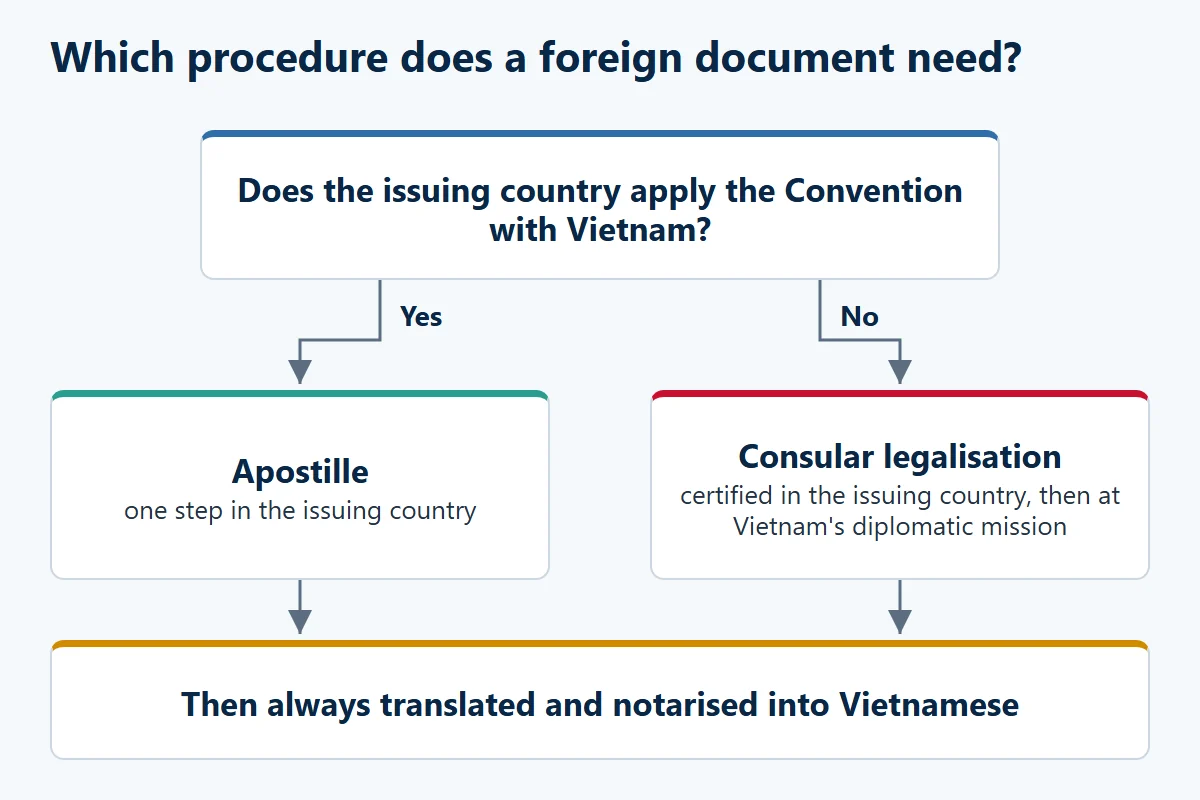
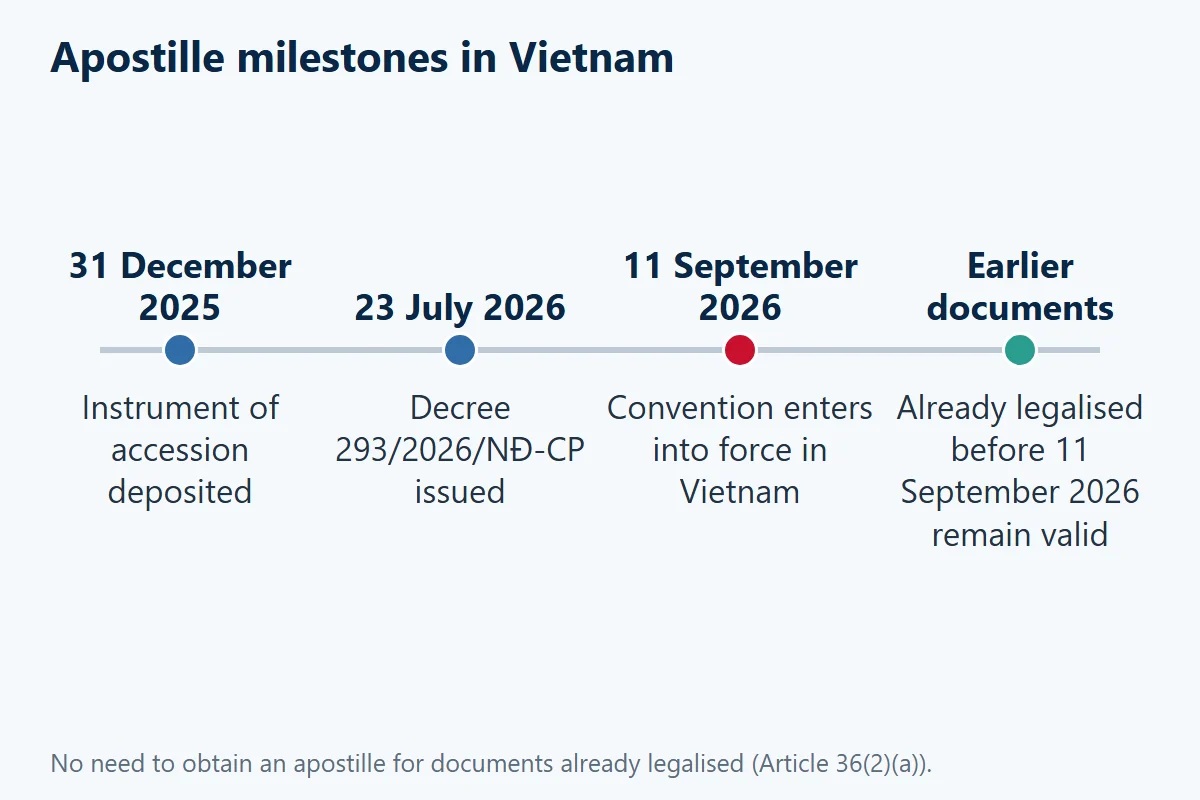
Yes — from 11 September 2026 Vietnam is a party to the 1961 Hague Convention Abolishing the Requirement of Legalisation for Foreign Public Documents (the Apostille Convention), so public documents from member states with which the Convention applies to Vietnam, bearing an apostille, are exempt from consular legalisation. Vietnam deposited its instrument of accession on 31 December 2025, and Decree 293/2026/ND-CP of 23 July 2026 implements it from 11 September 2026.
| Country issuing the document | Procedure |
|---|---|
| Convention member with which the Convention applies to Vietnam | Apostille, consular legalisation waived |
| Not a member, or a member with which the Convention does not apply to Vietnam | Full consular legalisation as before: certified in the issuing country then legalised at Vietnam's diplomatic mission |
What do apostilled documents need for use in Vietnam from 11 September 2026?
From 11 September 2026, a public document issued by a member state with which the Convention applies to Vietnam, bearing an apostille from that state's competent authority, can be used in Vietnam without consular legalisation, and Vietnamese authorities may not require any further certification (Article 25(2) and (3) of Decree 293/2026/ND-CP). The document must still be translated into Vietnamese, and the translation notarised or certified (Article 27(1)):
- Public documents include court and judicial documents, administrative documents such as degrees and criminal-record certificates, and notarial acts.
- An experience letter issued by a private company is not a public document; it usually has to be notarised in the issuing country first, and the apostille is then issued for that notarial act.
- Documents are refused where the apostille was not issued by a competent authority, lacks the title "Apostille (Convention de La Haye du 5 octobre 1961)", shows signs of forgery, has been revoked, or where the document is an administrative document directly related to commercial or customs operations (Article 26).
- Documents legalised before 11 September 2026 remain valid; no apostille needs to be added (Article 36(2)(a)).
For a work-permit file, an apostille usually shortens document preparation considerably, because one step in the issuing country replaces the chain of certification and legalisation. Before filing, check whether the issuing country has an applicable Convention relationship with Vietnam on the website of the Hague Conference on Private International Law (HCCH) or Vietnam's Consular Department.
Which documents must be legalised for a work permit?
The documents that typically need legalisation are those proving the worker's qualifications and background.
| Document | Needs legalisation? |
|---|---|
| University degree matching the position | Yes |
| Work-experience certificate | Yes |
| Criminal-record/judicial certificate issued abroad | Yes |
| Employer documents issued in Vietnam | No |
Once legalised, each is translated into Vietnamese and notarised.
How does notarised translation work in Vietnam?
After legalisation, foreign documents are translated into Vietnamese by a qualified translator and the translation is notarised so it is officially recognised. The volume of translation is what varies most between cases: a single assignee under a standard work permit needs a modest set, while an intra-corporate transfer with corporate decisions and relationship evidence across several countries needs a much larger set — which is why translation is priced by the actual documents rather than as a flat fee.
How much does legalisation and translation cost?
The notarised translation service starts at USD 260 per employee for a standard file, inclusive of government fees and exclusive only of 8% VAT, and rises with volume — around USD 1,040 for a multi-country intra-corporate transfer set. Consular legalisation for an intra-corporate transfer is quoted after reviewing the dossier, because it depends on how many countries are in the chain. Each item is priced separately so you pay for what your file actually needs — see the full menu in PEO cost in Vietnam 2026.
How long does legalisation take?
Legalisation is usually the longest part of the whole immigration timeline, because it runs through offices in the issuing country before the file even reaches Vietnam. This is why the work permit's 10-working-day issuance clock — which only starts on a complete, valid file — can be misleading if legalisation has not been planned. Start the legalisation and translation of foreign documents first, in parallel with everything else, to avoid it becoming the bottleneck.
Why Nhan Kiet
Nhan Kiet Supplying Manpower Co., Ltd (tax code 0308022768, established 2009) holds a labour sub-leasing licence (No. 15/2019/SHCM) and an employment-services licence (No. 22139/2023/45/SLDTBXH-VLATLD) issued in Ho Chi Minh City, and is certified to ISO 9001:2015, ISO 45001, ISO 14001 and ISO/IEC 27001:2022. We coordinate legalisation and notarised translation as part of the work permit file under our PEO service, so the paperwork is ready when the application is filed. For a quotation, call +84 908 636 108 (Mr Trung) or +84 28 3505 4224. This is general information, not legal advice.
See also: EOR services in Vietnam · Vietnam work permit for foreigners 2026: cost, documents, process · Vietnam work visa for foreign employees 2026: DN, LD, EV explained
Call +84 908 636 108 or see labour compliance, payroll outsourcing, EOR Vietnam.