
Insights
Vietnam work visa for foreign employees 2026: DN, LD, EV explained
 LinkedIn ↗
By Nguyen Quoc Trung — Deputy General Director · Updated
Which visa does a foreign employee need to work in Vietnam, and can they simply use a business visa? The visa is only one part of lawful employment — it must line up with the work permit and, for a longer stay, the residence card. This guide explains the main visa categories for foreign staff in 2026, why a business visa is not work authorisation, and what the entry visa costs.
Key facts (2026):
- A foreign employee needs an LD work visa (with a work permit); a DN business visa does NOT authorise work.
- Business visa categories are capped at 12 months; for a real assignment, move to a TRC.
- Nhan Kiet entry-visa service USD 250 per employee, all-in (incl. government fees), plus 8% VAT.
Which visa does a foreign employee in Vietnam need?
A foreign employee generally needs an LD work visa, granted on the basis of a work permit or a confirmation of work-permit exemption. The LD visa is the category tied to employment: broadly, it is issued to those who hold a work permit, and a separate exempt category covers people confirmed as not requiring one. A short entry can start on a business (DN) visa, but that does not by itself authorise work.
DN business visa vs LD work visa: what is the difference?
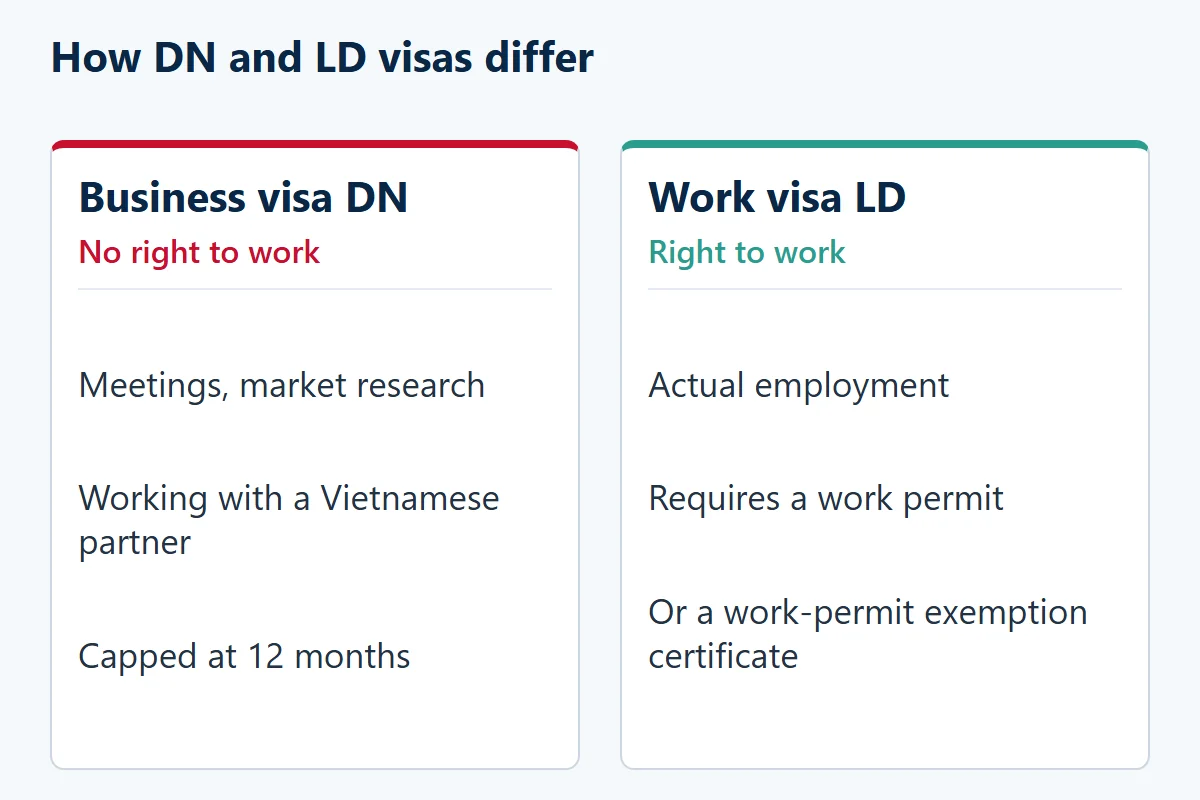
A DN business visa is for business activities such as meetings, market research and working with a Vietnamese partner, while an LD work visa is for actual employment backed by a work permit.
| Criterion | Business visa DN | Work visa LD |
|---|---|---|
| For | Meetings, market research, working with a Vietnamese partner | Actual employment backed by a work permit |
| Right to perform employment duties? | No | Yes |
| Term | Both DN categories capped at 12 months | Tied to the work permit |
The distinction matters because immigration and labour authorities treat performing employment duties on a business visa as unlicensed work, which carries penalties by headcount and, for the worker, expulsion.
Can you work in Vietnam on a business (DN) visa?
No — a business visa does not authorise employment. It facilitates visits, meetings and market entry activities, but the holder is not permitted to perform employment duties. A short-term business-visa route is sometimes suggested as a shortcut for a foreign hire, but it is not recommended: it exposes both the worker and the company to fines for unlicensed foreign labour. The compliant path is a work permit, then an LD visa or a Temporary Residence Card.
How long is a work visa valid?
An entry visa is short-term, and for a real assignment the worker moves onto a longer status. Business visa categories are capped at 12 months, and for someone staying for the assignment the practical destination is a Temporary Residence Card aligned with the work permit, which removes repeated visa renewals. The visa is best seen as the entry step, not the long-term basis for living and working here.
How much does the entry visa cost?
The Nhan Kiet service for the entry business visa (DN, single entry) is USD 250 per employee, inclusive of government fees and exclusive only of 8% VAT. It is priced on its own, so if the person is entering Vietnam for the first time you add it to the work permit and TRC; if they are already in-country on a valid status you may not need it. The full menu, with each service priced separately, is in PEO cost in Vietnam 2026.
From visa to work permit to TRC: the sequence
The lawful sequence is entry on the correct visa, then the work permit, then the Temporary Residence Card, and only then does the person work under a labour contract.
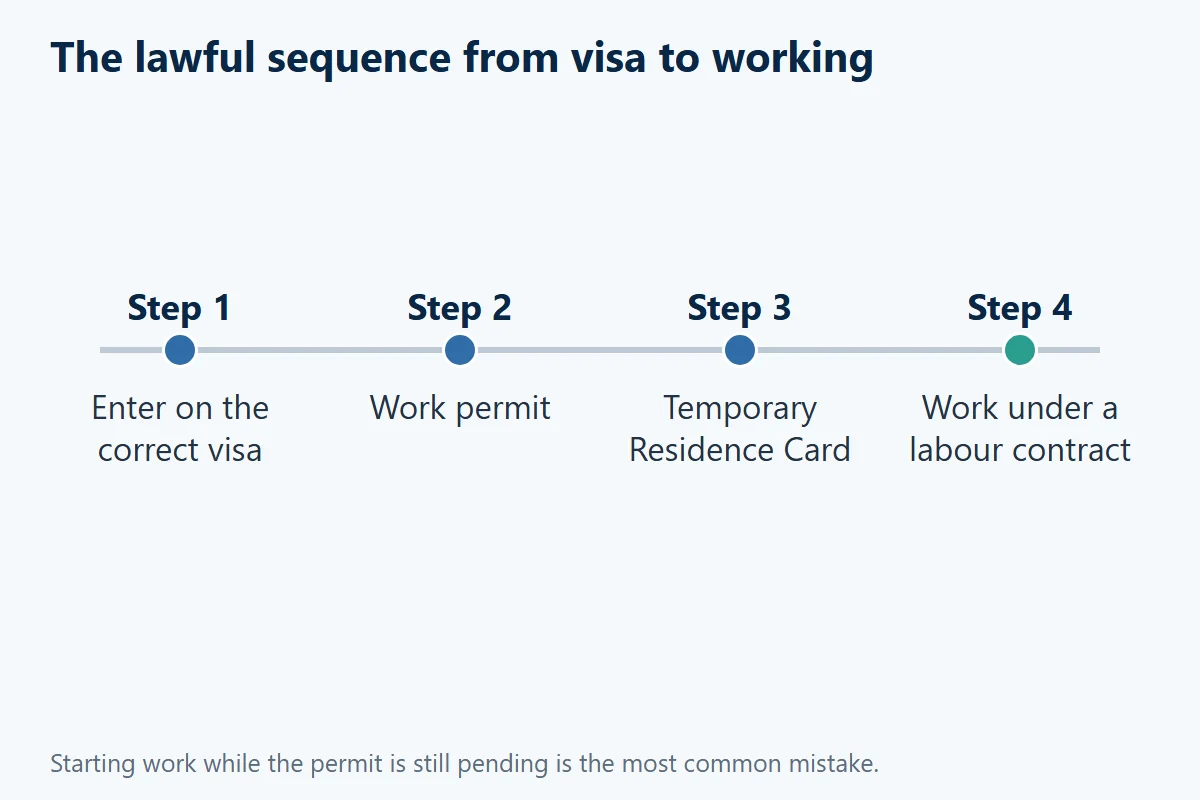
Getting the order wrong — for example starting work on a business visa while the permit is pending — is the most common compliance mistake. Under a PEO arrangement, Nhan Kiet sequences all three so the dates line up and there is no gap.
Why Nhan Kiet
Nhan Kiet Supplying Manpower Co., Ltd (tax code 0308022768, established 2009) holds a labour sub-leasing licence (No. 15/2019/SHCM) and an employment-services licence (No. 22139/2023/45/SLDTBXH-VLATLD) issued in Ho Chi Minh City, and is certified to ISO 9001:2015, ISO 45001, ISO 14001 and ISO/IEC 27001:2022. We arrange the entry visa alongside the work permit and TRC so the whole immigration file moves as one. For a quotation, call +84 908 636 108 (Mr Trung) or +84 28 3505 4224. This is general information, not legal advice.
See also: EOR services in Vietnam · Temporary Residence Card (TRC) in Vietnam 2026: cost and process · Vietnam work permit for foreigners 2026: cost, documents, process
Legal sources
Official texts (in Vietnamese) on the Vietnamese Government's legal portals:
- Law on Entry, Exit, Transit and Residence of Foreigners in Vietnam 2014 (No. 47/2014/QH13): the base law on visas, temporary residence cards and residence of foreigners
- Law amending the Law on Entry, Exit, Transit and Residence of Foreigners 2019 (No. 51/2019/QH14): Article 8 (visa codes DN1, DN2, LD1, LD2, DT1–DT4, EV) and Article 38 (residence card terms: LD1, LD2 up to 2 years, DT1 up to 10 years)
- Law amending the immigration laws 2023 (No. 23/2023/QH15): amends Article 9: e-visa (EV) up to 90 days; DN1, DN2 up to 1 year (in force from 15 August 2023)
- Labour Code 2019 (No. 45/2019/QH14)
- Decree 219/2025/ND-CP: foreign workers employed in Vietnam
- Decree 283/2026/ND-CP: administrative penalties in labour and social insurance
Call +84 908 636 108 or see labour compliance, payroll outsourcing, EOR Vietnam.